
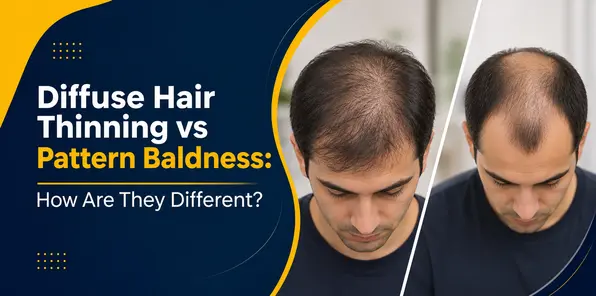
Hair loss looks different for everyone. For some, they begin to see their scalp become more visible due to hair loss all over the scalp. Others experience hair loss in specific areas such as the hairline, temples, and crown. These two types of hair loss are referred to as diffuse hair thinning and pattern baldness. Though they can both lead to reduced hair density, they differ in many other ways including the reason for the loss, and the symptoms and the way it progresses. It is important to recognize these differences to better understand the reason for hair loss. The early stages of hair loss can be detected by an individual, and this may lead them to seek an assessment of their scalp and look into treatment options that are available to them.
What Is Diffuse Hair Thinning?
Diffuse hair thinning refers to a decrease in hair density over a large area of the scalp. In this condition, hair looks less voluminous. People may also notice that their ponytail becomes thinner and their scalp becomes more visible.
Like other types of hair loss, hair thinning may also be diffuse, where it affects the top, sides and back of the scalp.
There are several causes of diffuse hair thinning, which include:
- Nutritional deficiencies: Sometimes, insufficient intake or deficiency of essential nutrients may result in hair thinning.
- Hormonal changes: Hair thinning is one of the signs of thyroid problems, as well as other hormonal changes.
- Emotional and physical stress: Increased shedding of hair may occur as a response to emotional and physical stresses, e.g. Illness, surgery, high fever, prolonged emotional stress, etc.
- Medicines: Some medicines may alter normal hair growth.
- Telogen effluvium: In this condition, a lot of hair follicles are pushed into the resting phase, thus resulting in increased shedding.
What Is Pattern Baldness?
Pattern Baldness is an inherited form of hair loss that is characteristically progressive. It is medically termed androgenetic alopecia. It is the same process in men and women; however, the exact pattern of hair loss is different in each gender.
This process is caused by genetics and the level of sensitivity of the hair follicles to androgens (male hormones) in particular Dihydrotestosterone (DHT). Over time the hair follicles shrink (miniaturization) and produce shorter and finer hair.
This is what pattern baldness looks like:
- For men: Hair loss around the crown and above the ears (temples).
- For women: Thinning of hair in the center of the scalp.
- Thinner hair: Over time, your hair becomes finer.
- Worsening condition: Without any treatment, your hair loss can increase.
How Can You Identify The Type Of Hair Loss?
To definitively determine what kind of hair loss you have takes a thorough evaluation by a dermatologist or a hair loss specialist. This includes looking at your scalp and assessing the pattern and distribution of hair loss.
The evaluation may include:
- Looking at your health history: This may include recent illnesses, stressful events, medications you have taken, your family history and recent changes in your diet.
- Looking at your scalp: This may show if your hair loss is localized to a particular area, or is uniform.
- Trichoscopy: This is a special magnification of the scalp to evaluate hair, follicles and other features of the scalp.
- Lab tests: If certain symptoms are present, lab tests may be ordered to evaluate thyroid function, test levels of various nutrients and your iron levels.
When Should You Consult A Hair Specialist?
If you notice changes in the density of your hair, don’t ignore it. It is best to address this in the early stages, as it can help to identify the cause of hair loss before it gets worse.
You should seek professional help if you experience any of the following:
- Sudden and excessive hair loss.
- Receding hairline and widening parting.
- Thinning hair that shows the scalp.
- Hair loss that continues for months.
- Scalp conditions that may cause itching, redness or discomfort.
- Tiredness, and other symptoms along with hair thinning.
Conclusion
Diffuse hair thinning and pattern baldness may look the same at first. However, the causes and progression of the conditions are different. The main feature of diffuse hair thinning is wide-spread thinning of hair in the scalp. On the other hand, pattern baldness is genetically determined and is progressive condition in which the number of terminal hair follicles gradually decreases. In some cases, both of the conditions may be observed at the same time and an expert opinion may be necessary for evaluation and diagnosis. The treatment and management of hair is planned based on the cause. Therefore, it is very important to find the cause.